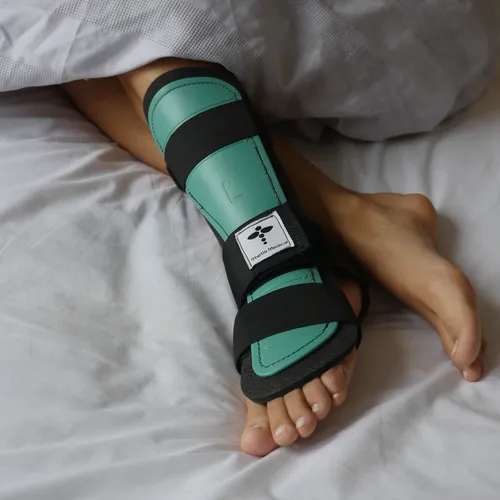
Return to running after Achilles rupture is not just about passing a strength test. Even when you meet the criteria to start, poor running mechanics or a rushed progression can still overload a healing tendon.
Running asks the Achilles to absorb and release force hundreds of times per minute. Late-stage rehabilitation is about rebuilding that repeated-load tolerance safely — with the right technique, the right surfaces, and a patient progression plan.
Contents
- Key takeaways
- When you are ready to start running
- Running technique that protects your tendon
- Best surfaces when returning to running
- How to progress running volume safely
- Warning signs: when to stop or step back
- What this means for your recovery
- Frequently asked questions
- References
Key takeaways
- Return to running should be criteria-based, not based on the calendar alone.
- A common late-stage benchmark is 25+ high-quality single-leg heel raises plus pain-free walking and clinician clearance.
- Early running technique should focus on shorter strides, softer landings, and upright posture.
- Start on flat, predictable surfaces — treadmill, grass, track, or flat trails — before hills or uneven ground.
- Increase volume before speed. Do not chase pace in the first weeks back.
- Progress only if pain and swelling stay calm during and after each session.
- A new pop, sudden sharp pain, or loss of push-off needs urgent medical review.
When you are ready to start running
Clearing you to run is not a single moment on a calendar. It is a set of functional checks that show your calf, tendon, and balance system can handle repeated impact.
Different hospitals and sports clinics use slightly different thresholds, but the themes are consistent:
| Checkpoint | What it usually means | Why it matters |
|---|---|---|
| 25+ single-leg heel raises | Repeated strong reps with good heel height | Tests calf endurance and push-off capacity |
| Pain-free walking | Normal gait without a limp | Shows basic load tolerance before impact |
| Good balance and control | Stable single-leg stance and squat control | Reduces sloppy, high-risk mechanics |
| Clinician clearance | Surgeon or physiotherapist agrees you are ready | Accounts for your surgery type, gap, and healing |
| Timeframe | Often around 12–16 weeks or later | Healing rates vary; criteria matter more than the date |
Silbernagel and colleagues, writing on return to sport after Achilles tendon repair, describe running initiation only after patients demonstrate meaningful calf strength, controlled single-leg movement, and good mechanics — typically no sooner than 12–16 weeks in accelerated pathways, and often later in everyday patient care.
That matches Thetis clinical guidance: return to running is criteria-based, with 25+ heel raises as a gold-standard strength target. Timing is secondary.
If you are still rebuilding basic strength, work through single-leg heel raise progression and functional milestones before you worry about pace.
Running technique that protects your tendon
Passing your criteria does not mean you can run exactly as you did before injury. Many patients still have calf asymmetry, tendon thickening, or subtle gait changes even when they feel “ready.”
Research on athletes after Achilles rupture shows common compensations: less knee flexion at initial contact, reduced ankle motion during push-off, and altered loading through the leg. These patterns can increase stress on the knee and Achilles if you return to hard running without attention to form.
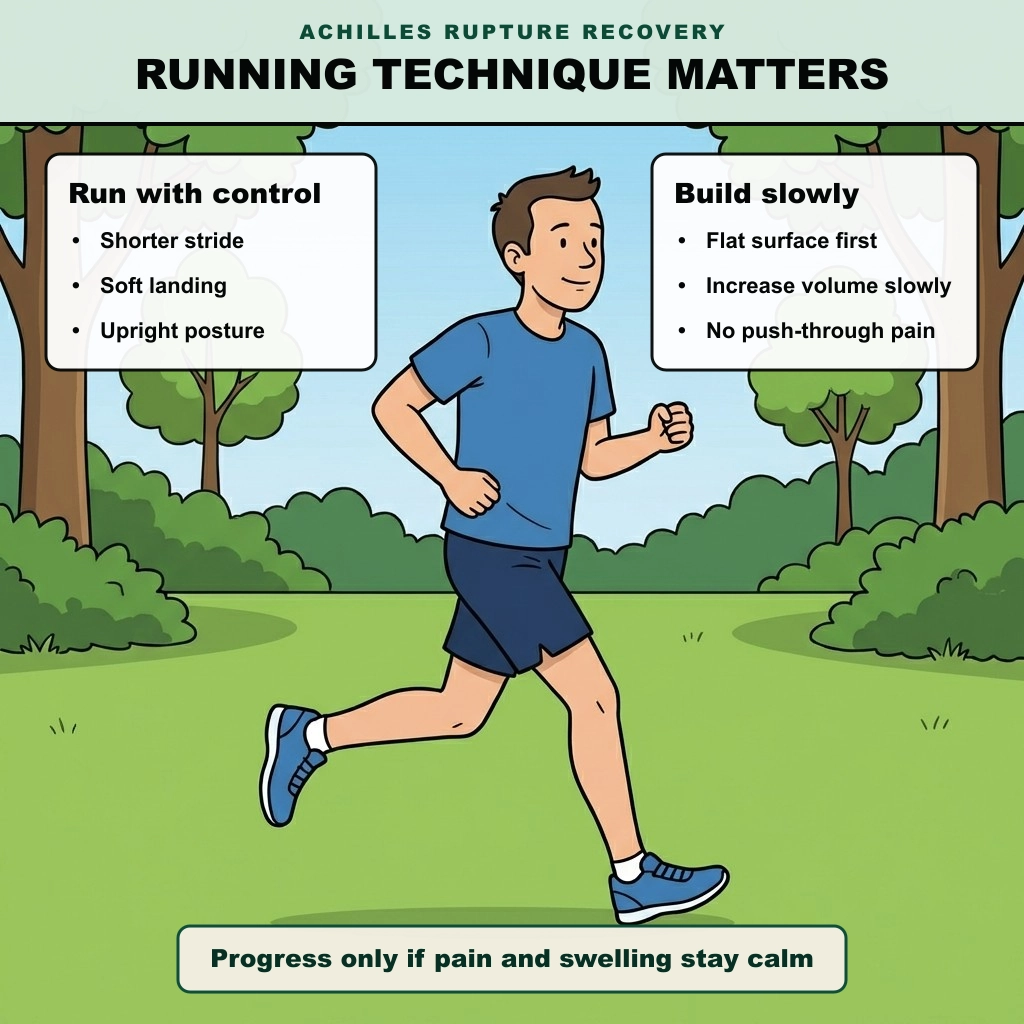
Early return-to-run technique should aim to lower peak tensile load on the tendon:
| Technique focus | What to do | Why it helps |
|---|---|---|
| Shorter stride | Keep your feet landing under your hips, not far in front | Overstriding increases braking force through the Achilles |
| Softer contact | Aim for a quiet, controlled landing | Smooths impact rather than pounding the ground |
| Upright posture | Avoid excessive forward lean from the waist | Reduces chronic high-tension demand on the calf-Achilles unit |
| Slightly quicker cadence | A small increase in step rate can help shorten stride | Biomechanics research links a modest cadence increase with lower peak Achilles stress |
| Volume over speed | Jog slowly; do not sprint early | Speed adds load faster than endurance |
You do not need a perfect gait analysis to start. You do need intentional control: shorter, quieter steps at an easy effort.
Some teams use pre-running drills — marching, skips, or short pogo hops — to rehearse stiffness and short contact times before full jogging. Ask your physiotherapist whether those fit your stage.
Best surfaces when returning to running
The ground beneath your feet changes how impact travels through the ankle. During the first weeks of running, predictability matters more than scenery.
Surfaces to start on
- Treadmill — flat, even, and easy to control speed and duration
- Level grass — some impact absorption, but check for holes and uneven patches
- Athletic track — consistent, flat, and measured for interval work
- Flat dirt trails — often softer than pavement, but only if the surface is smooth
Surfaces to avoid early on
- Hills — uphill and downhill both change Achilles load, especially deep dorsiflexion under load
- Uneven terrain — roots, camber, cobbles, and trail obstacles challenge balance before the tendon is ready
- Long continuous runs — distance is a load variable; build it slowly
- Sudden speed work — intervals, sprints, and fartlek sessions come later
Many hospital protocols, including walk-jog programs used in major sports-medicine centres, recommend softer, flatter surfaces during the first running phase. That is not because road running is forbidden forever — it is because early progression should remove unnecessary variables.
If you need cardiovascular work before running is cleared, low-impact cardio options such as pool walking, cycling, or elliptical training can help fitness without the same tendon demand.
How to progress running volume safely
The most common setbacks after Achilles rupture are not mysterious. They happen when patients return too early, progress too quickly, or push through pain and swelling.
A structured walk-jog plan is the standard bridge from strength work to continuous running. One widely used model starts with repeated walk-jog intervals — for example, alternating several minutes of walking with short jogs — and only moves to continuous jogging once each stage is tolerated without flare.
Practical progression rules:
- Increase one variable at a time — distance, speed, frequency, or surface; not all four in the same week.
- Use a modest weekly increase — many programmes follow a “10% rule,” adding no more than about 10% total running volume per week if symptoms stay calm.
- Keep easy days easy — alternate run days with non-impact or low-load work.
- Build distance before pace — steady slow jogging comes before tempo runs or intervals.
- Log next-day response — morning stiffness, swelling, and limp matter as much as pain during the run.
Rebuilding running capacity is about restoring tendon tolerance to repeated dynamic load over time. That adaptation does not happen in one weekend.
Even one year after rupture, research shows that some patients still have side-to-side differences in ankle motion and calf activation during running. So patience is not caution for its own sake — it reflects how long the tendon and neuromuscular system can take to normalise.
For broader late-stage planning, see preventing re-rupture after recovery and the structured guidance in the Achilles recovery course.
Warning signs: when to stop or step back
A good return-to-run plan is not “no pain, no gain.” It is calm symptoms, steady progress.
Step back one level — or stop and contact your clinician — if you notice:
- Sharp Achilles pain during or after running
- New swelling around the tendon or ankle
- A worse limp the next day
- Clearly worse morning stiffness after a run session
- Reduced heel-raise quality in the days after running
- A sudden pop, snap, or feeling of being kicked in the calf
- Sudden loss of push-off or confidence loading the leg
Whole-leg swelling up to the knee, calf pain, breathlessness, or chest pain should prompt medical review even if it seems unrelated to the ankle, because of clot risk after Achilles rupture.
If symptoms are mild and settle within 24 hours, you may only need to repeat the same stage rather than progress. If they persist or worsen, treat that as a signal that total load — running plus daily life, gym work, and sport — was too high.
What this means for your recovery
Meeting the criteria to start running is a real milestone. It means your calf and tendon have rebuilt enough capacity to begin handling impact again. But the first weeks of running are a technique and tolerance phase, not a fitness chase.
Focus on short, quiet strides on flat ground. Build volume slowly. Keep strengthening the calf on non-run days. And treat pain and swelling as useful feedback, not something to push through.
Return to sport — cutting, sprinting, and competition — is a later step with additional criteria such as hopping symmetry and confidence under load. Running is part of the pathway, not the finish line.
Work through this transition with your physiotherapist or surgeon. Protocols vary by country, treatment type, and activity level. The right plan is the one that matches your leg, not a generic timeline from social media.
For phase-by-phase guidance, see the Achilles rupture rehabilitation FAQ.
Frequently asked questions
When can I start running after Achilles rupture?
Return to running should be criteria-based, not date-based. Many teams look for 25+ single-leg heel raises, pain-free walking, good balance, and clinician clearance before starting a walk-jog program, often around 12–16 weeks or later depending on your pathway.
What running technique should I use after Achilles rupture?
Early running should emphasise shorter strides, quieter foot contact, upright posture, and a controlled cadence. The goal is to reduce peak load on the healing tendon, not to run fast.
What surfaces are best when returning to running?
Start on flat, predictable surfaces such as a treadmill, level grass, a track, or flat dirt trails. Avoid hills, uneven ground, and long distances until your tendon tolerates steady jogging without pain or swelling.
How do I progress from walk-jog to full running?
Use a structured walk-jog interval plan, increase only one variable at a time, and follow a modest weekly volume increase. Many protocols suggest no more than about 10% more running per week if symptoms stay calm.
What are warning signs to stop running after Achilles rupture?
Stop or step back if you get sharp Achilles pain, new swelling, a worse limp the next day, morning stiffness that is clearly worse, or a sudden pop or loss of push-off. Those symptoms mean the load was too high for your current tendon capacity.
References
- Silbernagel KG, Carmont MR, Grävare Silbernagel K. Rehabilitation and Return to Sports after Achilles Tendon Repair. International Journal of Sports Physical Therapy. 2023.
- Zhang S, Li H, Wang J, et al. Do athletes alter their running mechanics after an Achilles tendon rupture? PeerJ. 2017.
- Hafer JF, Brown AC, deMille P, Hillstrom HJ, Garber CE. The effect of a cadence retraining protocol on running biomechanics and efficiency: a pilot study. Journal of Sports Sciences. 2015.
- Rehabilitation Protocol for Achilles Rupture Repair — Return to Running Program. Massachusetts General Hospital Sports Physical Therapy. 2021.
- Silbernagel KG, Nilsson-Helander K, Thomee R, et al. A new measurement of heel-rise endurance with the ability to detect functional deficits in patients with Achilles tendon rupture. Knee Surgery, Sports Traumatology, Arthroscopy. 2010.
Primary source: Silbernagel KG, Carmont MR, Grävare Silbernagel K. Rehabilitation and Return to Sports after Achilles Tendon Repair