By around week 20 after an Achilles rupture, many patients are no longer asking, “When can I get out of the boot?” They are asking something more important: “Can I trust my leg again?”
That is the right question. At this stage, recovery is less about protection and more about function. The tendon may be biologically healing, but the calf, balance system, walking pattern, stair confidence, and trust in the leg still need rebuilding.
Contents
- Key takeaways
- Why functional milestones matter more than dates
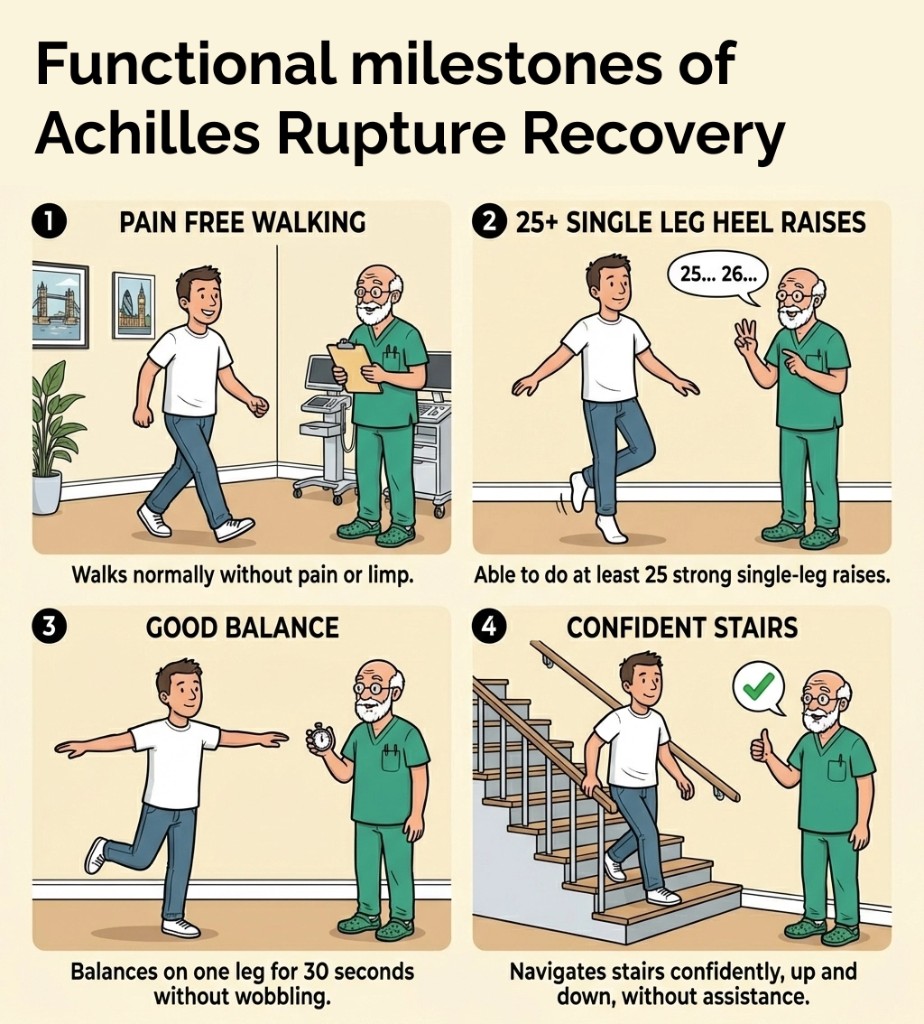
- Milestone 1: pain-free walking
- Milestone 2: 25+ single-leg heel raises
- Milestone 3: good balance and control
- Milestone 4: confident stairs
- How to identify your biggest recovery gap
- What this means for your recovery
- Frequently asked questions
- References
Key takeaways
- Late-stage Achilles rupture recovery is about function, not just tendon healing.
- Pain-free walking without a limp is one of the first meaningful signs that gait mechanics are improving.
- 25+ high-quality single-leg heel raises is a useful strength target, but heel height and control matter too.
- Balance and stair confidence often lag behind basic walking.
- Week 20 is not a pass-or-fail deadline. Patients recover at different speeds.
- The real question is: which gap still limits you most: strength, balance, walking mechanics, stairs, or confidence?
Why functional milestones matter more than dates
Recovery timelines are useful, but they can also mislead. Two patients can both be at week 20 and look completely different. One may walk well but still have poor single-leg strength. Another may be strong in the gym but nervous on stairs or uneven ground.
This is why modern Achilles rehabilitation should be criteria-based. The calendar tells you roughly where you are. Functional milestones tell you what your leg can actually do.
Research on heel-rise testing makes this point clearly. Silbernagel and colleagues found that repetition count alone can make recovery look better than it is. At 12 months, patients averaged 95% limb symmetry for heel-rise repetitions, but only 76% symmetry when heel-rise work was measured, because height and quality still lagged. In plain language: doing the reps is not the same as recovering full push-off power.
For broader context on late deficits, see long-term strength after Achilles rupture.
Milestone 1: pain-free walking
Pain-free walking is not just “I can get around.” It means your walking pattern is becoming efficient again.
Look for:
- Normal heel-to-toe gait
- No obvious limp
- Minimal or no Achilles pain during walking
- No delayed swelling or stiffness the next morning
- No need to shorten your step to protect the tendon
Walking is the foundation for later running, hiking, sport, and normal daily life. If you still limp, that is not a moral failure. It is a signal. The most common reasons are calf weakness, stiffness, fear, swelling, or poor push-off.
If walking has worsened after leaving the boot, revisit walking boot removal timing and discuss your progression with your physiotherapist.
Milestone 2: 25+ single-leg heel raises
The single-leg heel raise is one of the most useful strength markers after Achilles rupture. It asks one calf-tendon unit to lift your bodyweight repeatedly while maintaining control.
A late-stage target often used in modern pathways is 25+ high-quality single-leg heel raises. But the word “high-quality” matters.
| What to check | Good sign | Caution sign |
|---|---|---|
| Repetitions | Can build toward 25+ controlled reps | Stops early because the calf fades or cramps |
| Heel height | Heel rises close to the uninjured side | Reps are counted but the heel barely lifts |
| Control | Smooth up and down, no bouncing | Uses momentum or bends the knee to cheat |
| Symptoms | No next-day flare | More swelling, stiffness, or limp afterward |
Many clinicians treat lower numbers, such as 10-15 clean reps, as earlier progress markers. That is useful. But for higher-level activity, the goal is usually not just “can you do one?” It is whether the calf has enough endurance and control for repeated push-off.
For the full progression ladder, read single-leg heel raises after Achilles rupture.
Milestone 3: good balance and control
After weeks in a boot, many people feel that the leg is “not mine.” That is not just weakness. Immobilisation can reduce proprioception, which is your body’s sense of where the foot and ankle are in space.
A simple milestone is single-leg balance for 30 seconds with good control. The goal is not circus-level balance. The goal is a steady, confident stance without grabbing support, collapsing inward, or feeling close to falling.
Useful signs include:
- Less wobbling during single-leg stance
- Better control when shifting weight
- More confidence on uneven ground
- Fewer protective movements or sudden grabs for support
Balance is also a safety issue. A trip, slip, or sudden uncontrolled step can force the ankle into a position the tendon is not ready for. That is why balance training should be progressed gradually, starting near a stable support.
For practical balance steps, see Achilles rehab balance and neuromuscular control.
Milestone 4: confident stairs
Stairs expose gaps that flat walking can hide. Going up needs calf strength and push-off. Going down needs control, ankle range, balance, and confidence.
A useful milestone is being able to go up and down stairs with:
- Controlled foot placement
- Less reliance on the railing
- No sudden drop or collapse
- No marked increase in pain or swelling afterward
- Confidence rather than hesitation
Do not rush this. Some patients walk well on flat ground but still struggle with stairs for weeks or months. That usually means the calf-tendon unit is not yet strong or coordinated enough for repeated single-leg loading.
If stairs feel risky, use the railing and slow the movement down. Safer practice beats brave compensations.
How to identify your biggest recovery gap
Late-stage rehab works best when you stop asking only, “What week am I?” and start asking, “What function is missing?”
| If you struggle with… | The likely gap may be… | What to discuss with your physio |
|---|---|---|
| Limping or short steps | Walking mechanics, calf weakness, fear, swelling | Gait retraining and load management |
| Few heel raises | Calf strength or tendon capacity | Progressive calf loading |
| Low heel height | Tendon elongation, calf weakness, poor push-off | Heel-rise quality and side-to-side comparison |
| Wobbling | Balance and neuromuscular control | Single-leg stance progression |
| Stairs | Strength, ankle control, confidence | Step-ups, step-downs, and stair-specific practice |
| Avoiding activity | Fear or low trust in the leg | Graded exposure and clear criteria |
The point is not to pass every test immediately. The point is to identify the next bottleneck.
What this means for your recovery
At this stage, the tendon may be healed enough for more activity, but the whole leg still needs retraining. Strength without balance is not enough. Balance without calf capacity is not enough. Walking well on flat ground does not automatically mean stairs, running, or sport are ready.
Use milestones as a dashboard, not a judgement. If one area is behind, focus your rehab there. If symptoms rise after a new exercise or longer walk, reduce the dose and build again.
Seek urgent medical review if you feel a sudden pop, sharp pain, loss of push-off, a new gap in the tendon area, or a sudden major change in walking. If swelling climbs up the whole leg, especially with calf pain, breathlessness, or chest pain, seek urgent review for a possible blood clot.
For a structured plan that ties milestones together, see the Achilles recovery course and the Achilles rupture rehabilitation FAQ.
Frequently asked questions
What are the most important Achilles rupture recovery milestones?
The most useful late-stage milestones are pain-free walking without a limp, strong single-leg heel raises, good single-leg balance, confident stair control, and enough trust in the leg to progress daily activities safely.
Why are 25 single-leg heel raises used after Achilles rupture?
Twenty-five high-quality single-leg heel raises is a practical late-stage strength target because it tests calf endurance, tendon capacity, and push-off control. Quality, height, and side-to-side symmetry matter as much as the number.
Is week 20 a normal time to still feel unsure after Achilles rupture?
Yes. Around week 20 many patients are walking better but still notice gaps in strength, balance, stairs, or confidence. Recovery is rarely linear, and progression should follow function rather than the calendar alone.
What does pain-free walking mean after Achilles rupture?
It means walking with a normal heel-to-toe pattern, no obvious limp, and minimal or no Achilles pain during or after the walk. A worse limp or next-day swelling usually means the dose was too high.
When can I return to running after Achilles rupture?
Return to running should be criteria-based, not date-based. Many teams look for pain-free walking, good calf strength, controlled single-leg heel raises, balance, and clinician clearance before introducing running.
References
- Silbernagel KG, Nilsson-Helander K, Thomee R, et al. A new measurement of heel-rise endurance with the ability to detect functional deficits in patients with Achilles tendon rupture. Knee Surgery, Sports Traumatology, Arthroscopy. 2010.
- Silbernagel KG, Steele R, Manal K. Deficits in Heel-Rise Height and Achilles Tendon Elongation Occur in Patients Recovering from an Achilles Tendon Rupture. American Journal of Sports Medicine. 2012.
- Brorsson A, Willy RW, Tranberg R, Grävare Silbernagel K. Heel-Rise Height Deficit 1 Year After Achilles Tendon Rupture Relates to Changes in Ankle Biomechanics 6 Years After Injury. American Journal of Sports Medicine. 2017.
- Zellers JA, Carmont MR, Grävare Silbernagel K. Defining Components of Early Functional Rehabilitation for Acute Achilles Tendon Rupture: A Systematic Review. Orthopaedic Journal of Sports Medicine. 2019.
- Royal Berkshire NHS Foundation Trust. Achilles Tendon Rupture: Management and Rehabilitation.
Primary source: Silbernagel KG, Nilsson-Helander K, Thomee R, et al.. A new measurement of heel-rise endurance with the ability to detect functional deficits in patients with Achilles tendon rupture