If you are asking about post-boot Achilles transition, you are asking the right question. Many patients see week 10 to 12 as the finish line, but this is often the hidden risk phase: you are no longer protected by a rigid boot, yet the tendon is still remodeling and vulnerable to overload.
The biggest mistake is treating boot removal as an on/off switch. The safer model is a gradual weaning process that reintroduces shoe time and tendon load step by step, while monitoring symptoms and gait quality.
Contents
- Key takeaways
- Why this phase is risky
- A practical day-by-day weaning template
- How to monitor your response
- What this means for your recovery
- Frequently asked questions
- References
Key takeaways
- Boot removal around weeks 10-12 is usually a criteria-based transition, not a fixed date.
- A gradual shoe wean (for example, over about 7 days) can reduce abrupt loading spikes.
- Heel lifts can help reduce dorsiflexion demand during early shoe walking.
- Aggressive early stretching is usually the wrong move in this window.
- The main risk of rushing is tendon elongation, which can reduce long-term push-off power.
- Symptoms and gait quality should guide pace more than calendar pressure.
Why this phase is risky
Inside a boot, your ankle angle and rollover are externally controlled. Outside the boot, your tendon suddenly sees:
- More dorsiflexion exposure,
- Different plantar pressure patterns,
- Less external support for calf-tendon loading control.
That jump matters. Studies on Achilles rupture recovery repeatedly link tendon length changes to heel-rise function. In plain language: if the tendon heals long, many people feel weaker at push-off later (Silbernagel and colleagues).
This is why many teams avoid abrupt transitions and instead emphasize load progression and movement quality. It also matches broader functional-rehab evidence, where successful outcomes depend on how progression is managed, not just whether surgery happened.
A practical day-by-day weaning template
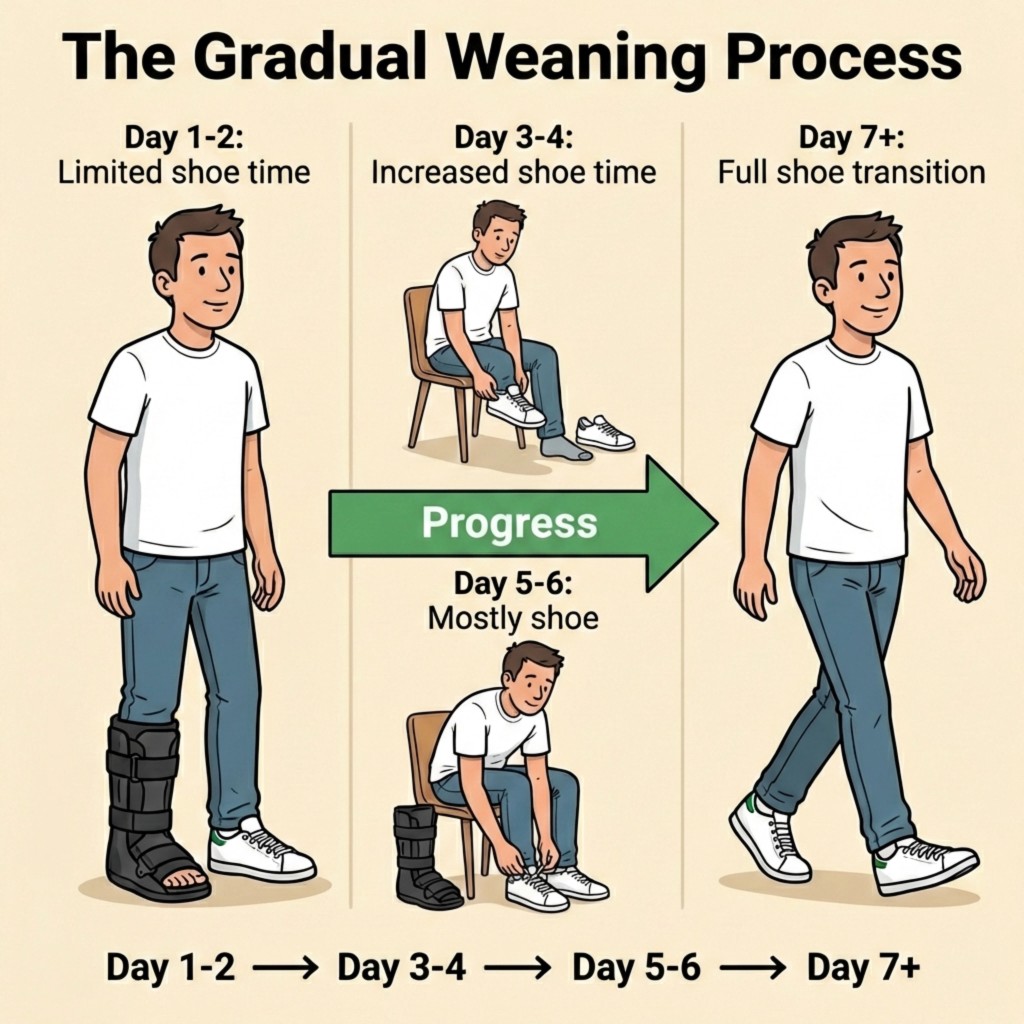
Your infographic model is useful as a patient-friendly structure:
| Transition day | Typical goal |
|---|---|
| Day 1-2 | Limited shoe time only (short, controlled periods) |
| Day 3-4 | Increase shoe time if symptoms stay calm |
| Day 5-6 | Majority of day in shoes, keep monitoring response |
| Day 7+ | Full transition if gait and symptoms remain acceptable |
Important: this is a template, not a compulsory timeline. Some patients need more than 7 days, especially if swelling rises, gait becomes asymmetric, or pain lingers after activity.
Helpful transition supports often include:
- Heel lifts in both shoes (as prescribed),
- Short, frequent walks rather than one long walk,
- Planned rest windows,
- No abrupt jump to hills, stairs volume, or fast pace.
For detailed boot-off timing context, see when to remove the walking boot and boot wedge removal protocol.
How to monitor your response
During weaning, use simple daily checks:
| What to check | Why it matters | Red flag trend |
|---|---|---|
| Morning stiffness | Reflects tendon irritability after prior-day load | Progressively worse each day |
| Swelling around tendon/ankle | Marker of load tolerance | Swelling that keeps increasing |
| Gait quality | Early signal of compensation | Limp, hip hitch, short push-off |
| Pain response over 24h | Better than judging by in-session pain only | Pain still elevated next day |
If these trend in the wrong direction, do not panic - de-load, slow the plan, and check with your clinician.
What this means for your recovery
Do:
- Treat boot removal as a progression block, not a graduation ceremony.
- Follow a structured weaning plan and adapt pace to symptoms.
- Keep heel lifts and footwear advice consistent with your clinic plan.
- Focus on smooth gait and calf control, not step-count ego.
Avoid:
- Throwing away the boot and walking full days immediately.
- Forceful dorsiflexion stretching in early shoe days.
- Ignoring swelling and stiffness because “the date says I should be fine.”
If you want a broader framework for this stage, the Achilles rupture rehabilitation FAQ and recovery course cover progression logic in plain language.
Frequently asked questions
When do patients usually come out of the boot after Achilles rupture?
Many teams discuss transition around weeks 10 to 12, but it is criteria-based. Function, symptoms, and gait quality should decide pace.
Is a 7-day weaning plan mandatory for everyone?
No. It is a practical starting framework. Some people need slower progression depending on response.
Do heel lifts help during post-boot transition?
They are commonly used to reduce dorsiflexion demand and smooth the loading jump into shoes.
What is the main risk if transition is too fast?
Rushing can increase elongation risk and produce persistent gait asymmetry or weak push-off.
Should I start aggressive stretching when the boot comes off?
No. Early aggressive stretching is usually avoided; controlled load progression is prioritized.
References
-
Silbernagel KG, Steele R, Manal K. Deficits in Heel-Rise Height and Achilles Tendon Elongation Occur in Patients Recovering from an Achilles Tendon Rupture. Am J Sports Med. 2012;40(7):1568-1575. https://doi.org/10.1177/0363546512447926
-
Willits K, Amendola A, Bryant D, et al. Operative versus Nonoperative Treatment of Acute Achilles Tendon Ruptures: A Multicenter Randomized Trial Using Accelerated Functional Rehabilitation. J Bone Joint Surg Am. 2010;92(17):2767-2775. https://doi.org/10.2106/JBJS.I.01401
-
Zellers JA, Carmont MR, Grävare Silbernagel K. Defining Components of Early Functional Rehabilitation for Acute Achilles Tendon Rupture: A Systematic Review. Orthop J Sports Med. 2019;7(11):2325967119884071. https://doi.org/10.1177/2325967119884071
-
Hullfish TJ, Woods MM, Kwon MP, Boakye LA, Humbyrd CJ, Baxter JR. The Difference in Achilles Tendon Loading within Immobilizing Boots Based on Ankle Angle, Boot Type, and Walking Speed. Orthop J Sports Med. 2024;12(10):23259671241283806. https://doi.org/10.1177/23259671241283806
Primary source: Silbernagel KG, Steele R, Manal K. Deficits in Heel-Rise Height and Achilles Tendon Elongation Occur in Patients Recovering from an Achilles Tendon Rupture